The Psychology Board of Australia has now released its report following consultation on proposed changes to the way psychologists are educated and trained in Australia.
There is still a lot to be worked through. The proposed model requires government consideration and many of the details around implementation, supervision and transition have not yet been determined. However, we now have a much clearer picture of what the future pathway could look like.
For anyone planning to become a Clinical, Educational and Developmental, or other endorsed psychologist, there are some important changes to understand.
One of the biggest changes is a much clearer separation between becoming a
generally registered psychologist and completing training for an
Area of Practice Endorsement (AoPE).
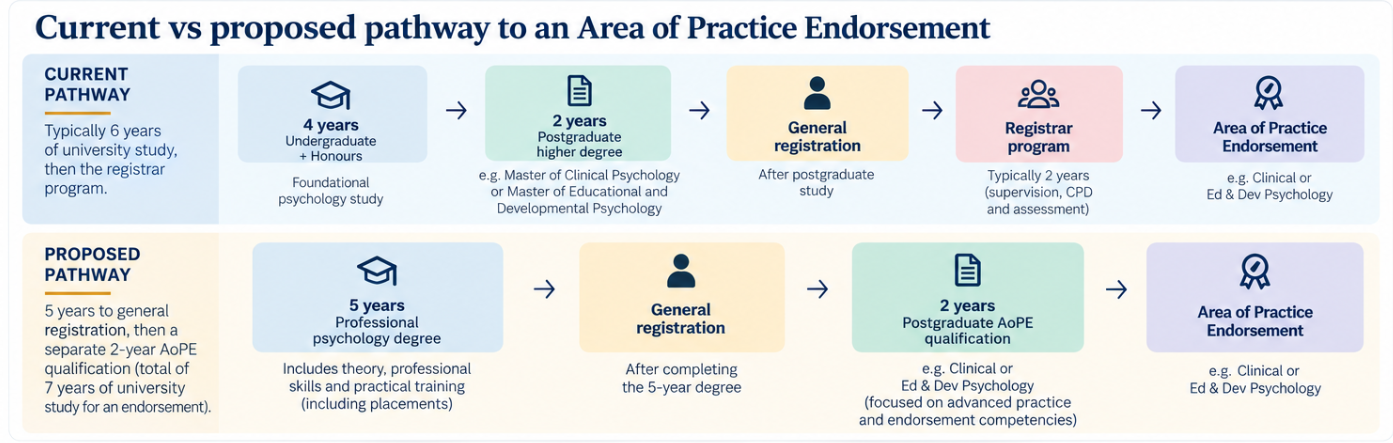
Under the proposed model, students would complete a five-year accredited psychology program leading to eligibility for general registration.
Psychologists wanting an Area of Practice Endorsement would then complete a separate two-year accredited postgraduate AoPE qualification after gaining general registration.
This is quite different from the current higher-degree pathway. At present, postgraduate study in an endorsed area generally contributes towards eligibility for general registration, followed by completion of the registrar program.
Under the proposed model, you would become a psychologist first and then undertake your advanced training in an endorsed area.
For students, one of the most significant changes is the potential to reach general registration after five years rather than six.
Professional skills would be developed progressively throughout the five-year program, with practical training and placements occurring before graduation.
Importantly, the Board has said that the competency threshold for general registration is not proposed to be lowered. Graduates would still need to demonstrate the professional competencies required for safe and effective practice.
For someone ultimately planning an endorsement, this creates a clearer distinction between training to become a psychologist and advanced training within a particular area of psychology.
It also potentially means entering the workforce as a generally registered psychologist a year earlier.
This is an important part of the proposal that can easily get lost in the discussion about shortening psychology training.
The pathway to general registration would reduce from six years to five.
The pathway for someone wanting an Area of Practice Endorsement, however, would involve five years to general registration followed by another two years of postgraduate AoPE training.
That potentially means seven years of formal university study, compared with the six-year higher-degree pathway commonly undertaken before commencing the registrar program under the current system.
So, while future psychologists could become generally registered sooner, those wanting an endorsement may spend longer at university overall.
This is where the picture becomes more complicated.
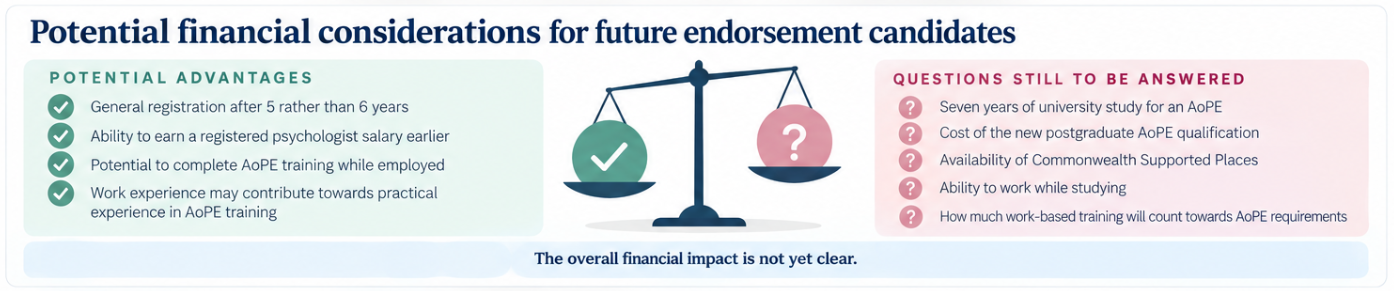
Reaching general registration after five years could allow psychologists to enter the workforce and earn a registered psychologist income a year earlier.
There is also the possibility that psychologists could remain in paid employment while completing their AoPE qualification. The Board has proposed that work experience may be able to count towards practical experience during AoPE training, rather than relying solely on traditional university placements.
On the other hand, future endorsement candidates may be committing to an additional year of formal university education overall.
There are still some important questions we do not have answers to. How much will the new postgraduate AoPE qualification cost? How many Commonwealth Supported Places will be available? Will psychologists realistically be able to work while studying? How much of their employment will count towards the practical requirements of their AoPE?
Until we know more about the structure and funding of the new qualifications, it is difficult to know whether future psychologists pursuing endorsement would ultimately be financially better or worse off.
Another interesting part of the proposal is the way practical experience could be completed.
The Board is proposing that work experience could count as practical experience within AoPE training, rather than psychologists necessarily having to complete traditional university placements.
AoPE programs would still need to be accredited and psychologists would still need to develop and demonstrate the relevant endorsement competencies.
For someone who is already generally registered, this could mean completing advanced training while working as a psychologist, with employment, supervision and postgraduate education all contributing to their development.
Exactly how this would work has not yet been determined.
This is probably the question we are most interested in at PREP.
At this stage, we don't know.
The report gives us a clearer picture of the proposed two-year AoPE qualification, but it does not provide enough detail to determine exactly how the existing registrar program would fit within the new structure.
There are some significant questions still to be answered.
Will the requirements currently completed through the registrar program become part of the new two-year qualification? Will there still be a period of supervised practice after the postgraduate qualification? What will happen to current supervision and CPD requirements? How will endorsement competencies be assessed?
We also do not yet know what transition arrangements will look like for psychologists who are already part-way through their training when a new system is introduced.
These details will make a substantial difference to what the future pathway to endorsement actually looks like.
For now,
nothing changes.The proposed reforms describe a possible future training model. There is still considerable work required before a new pathway could be introduced, including government consideration, development of accreditation requirements, university course development, planning for placements and supervision, and transition arrangements.
If you are currently completing a psychology degree, postgraduate program or registrar program, you should continue following the requirements that currently apply to your pathway.

At this stage, PREP isn't changing.
Our Clinical Psychology and Educational and Developmental Psychology registrar programs will continue to support psychologists completing the current requirements for endorsement.
We will, however, be watching the reform process closely.
PREP currently brings together individual and group supervision, structured CPD, experienced endorsed supervisors and support for registrars developing advanced competencies. Where these elements sit within a future AoPE pathway may change as the new model is developed.
There is still a lot we don't know about the proposed two-year AoPE qualification, the future of the registrar program, supervision requirements, practical experience and transition arrangements.
We will continue to provide updates as those details become clearer.
For future psychologists considering an endorsement, the main thing to understand at this stage is that the proposal is not simply about reducing psychology training from six years to five.
It proposes five years to become a generally registered psychologist, followed by a separate pathway for advanced training and endorsement that could involve a total of seven years of formal university study.
What happens within those final two years, and what happens to the registrar program that currently follows postgraduate study, will be important details to watch.